Tel: (818) 347-9665 PST

TheMuseumSFV@gmail.com

www.TheMuseumSFV.org


Showing posts with label World War II. Show all posts

Monday, July 14, 2014

REPUBLIC OF FRANCE HONORS VALLEY VETS WITH LÉGION d"HONNEUR

BUILDING A GREAT MUSEUM FOR THE SAN FERNANDO VALLEY

     Continuing The Museum's ongoing program, "Narrating Lives" Oral Histories of the San Fernando Valley, Lee Davis project director had some very special guests at our July 8th Board meeting. Lee invited leaders of the San Fernando Valley veterans organization, Wings of Wendys, to discuss ways The Museum can include veterans' histories with upcoming exhibits in our new Northridge space. A special emphasis will made to allow Valley school children to learn about the sacrifices made by veterans and their families for American freedoms. The vets will also be included in The Museum's Speakers Series. 

Accompanied by volunteer Paul Magosian (center in blue) leaders of Wings Over Wendys veterans association discuss an affiliation with The Museum to bring veterans' histories to the San Fernando Valley. 
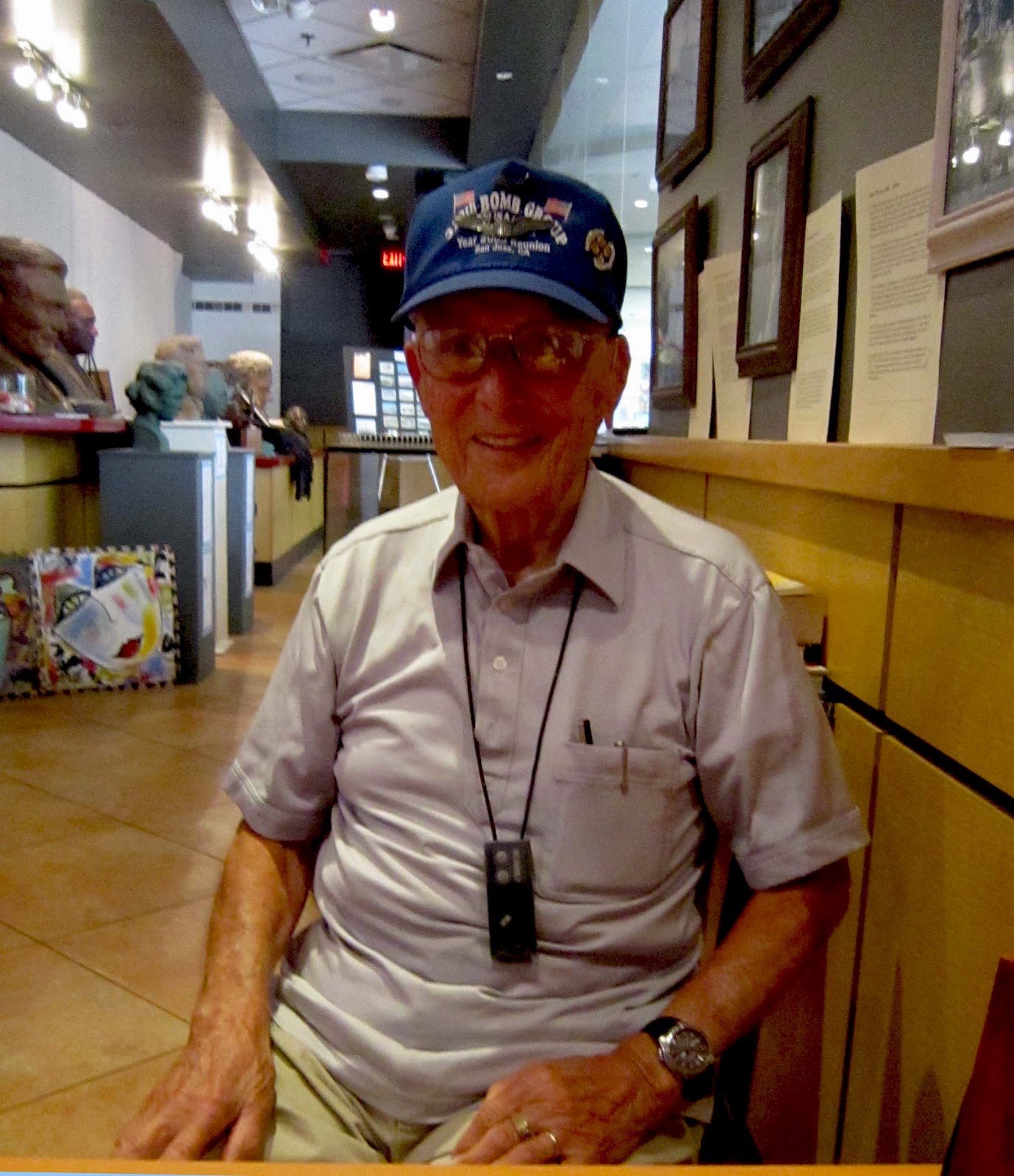
Right is Michael LaVere of West Hills, a survivor of 36 B-14 combat missions over Germany as a naigator during World War II. Mr. LaVere, age 84, was recently honored by the Republic of France with its cherished medal of the Légion d'Honneur
At right is Art Sherman, leader of the Wings of Wendy's association. was a bombardier during the Second World War. Art is leading discussions between The Museum and Wings of Wendys to secure veterans' histories. Mr.Sherman was also honored by the Republic of France with its revered medal of the Légion d'Honneur.

President Scott Sterling addresses Museum Board and guests at July meeting, at newly painted Museum space in Northridge.  (click on images to enlarge them)

Tuesday, June 10, 2014

IMAGES OF VINTAGE BURBANK

BUILDING A GREAT MUSEUM FOR THE SAN FERNANDO VALLEY

Overtime your Museum has begun to acquire a collection of photographs, postcards, books and supportive materials about the San Fernando Valley's premier city of Burbank. While vintage postcards generally give only glowing images of any location, they provide important overviews of a community. When postcards, such as the Lockheed Aircraft Factory School, contain messages they become evidence of a bigger picture, in this case World War II. 

Army Chapel - Lockheed Aircraft Factory School, Burbank, California - historic postcard- Gift to The Museum of the San Fernando Valley from Gary Fredburg 2014 (click on images to enlarge them.)
Note:  The information on this card reveals the Lockheed Aircraft factory in Burbank, likely to have been considered sensitive war-related prior to its mailing on February 23, 1945. It was mailed from PFC Justin O. Ranger (BK21-72$ 19127377 /  3715 AAFBU (class 30 -45) Lockheed Factory School, Burbank, California.
To: Mrs. Linn B. Ranger  775 North Town Avenue, Pomona, California.
It reads:  Dear Mom, This may get home Saturday, before I do, as I found a quicker way to send it off. Today, I feel much up to par, and pretty well out of my cold. I had a haircut tonight, and waited out (in) a line for an hour. I'll be home later, as I won't get through school and calestehjnics till five and will leave post about six. I was warmer this morning. Love Justin."  (postage free - North Hollywood)

 NBC Company postcard
 Gift to The Museum of the San Fernando Valley from Gary Fredburg 2014

Warner Brothers Studios, postcard- Gift to The Museum of the San Fernando Valley from Gary Fredburg 2014

Thursday, June 5, 2014

OLIVE VIEW HOSPITAL

BUILDING A GREAT MUSEUM FOR THE SAN FERNANDO VALLEY

In the first decade of the 20th century, the north eastern areas of the San Fernando Valley were widely believed to have the best climate, and healthiest air, in America. For that reason, Saint Frances Xavier Cabrini and her nuns established a boarding school in northern Burbank as a place of refuge for girls cramped into the dank sweatshops of the eastern seaboard. 
In 1920, a tuberculosis sanitarium was establhed in Sylmar, and was soon acclaimed to be one of the best such hospitals in the United States. During World War II Olive View was quietly prepared to received what was possibly thousands of wounded soldiers expected from an invasion of the mainland of Japan. This was true also of Birmingham Hospital (now Birmingham High School in Lake Balboa.) 

 The surgical wing of Olive View Hospital c. 1940 - Historic postcard - Gift to The Museum of the San Fernando Valley from Gary Fredburg 2014.  (click on images to enlarge them.)

 A few of the Women's Wards: Olive View Hospital c. 1940 - Historic postcard - Gift to The Museum of the San Fernando Valley from Gary Fredburg 2014. 

With tuberculosis contained, the hospital complex was retooled as an acute care hospital in 1962, in which the first successful open heart surgery was performed in the San Fernando Valley. Many of the buildings and landscaping of Olive View Hospital were destroyed in the San Fernando Earthquake of 1971.

Tuesday, March 18, 2014

NORTHRIDGE SERVICEMAN DUDLEY AMBROSE WAS IN HARM'S WAY IN WORLD WAR II


BUILDING A GREAT MUSEUM FOR THE SAN FERNANDO VALLEY


                                                            Dudley C. Amrose Jr.
1943 Valley Times Honor Roll Album - Gift to The Museum of the San Fernando Valley from Dennis Spiegelman  2014.  (click on image to enlarge it.)    


"Dudley C Ambrose Junior, is a storekeeper with the Merchant Marine, which he entered June 2, 1941, but has had much overseas duty in that branch of the service. He has been on convoy convoy duty since Pearl Harbor and seen action at Pearl Harbor, Guadalcanal, in Australia, New Zealand and other South Pacific islands. On one trip he was wounded by shrapnel from a Japanese dive bomber. His parents, Mr. and Mrs. DC Ambrose live at ---- Jellico Ave., Northridge."

Support The Museum's collection of Valley military service history
Donate tax-deductible videos, photographs, records and other artifacts to your Museum today.
The Museum of the San Fernando Valley
Acquisitions Committee
gary.fredburg@TheMuseumSFV.org
21031 Ventura Blvd., Suite 419  (mailing address)
Woodland Hills, CA 91364-2230

THE MUSEUM’S TELEPHONE
1 (818) 347-9665

THE MUSEUM'S EMAILS
gerald.fecht@TheMuseumSFV.org

info@TheMuseumSFV.org

THE MUSEUM’S BLOG

THE MUSEUM’S WEBSITE
www.TheMuseumSFV.org

Tuesday, May 7, 2013

A WORLD WAR II LETTER FROM THE PHILIPPINES IN 1944

CHERISHING OUR VALLEY        2013

The veterans who built the San Fernando Valley at the conclusion of World War brought with them incredible memories almost incomprehensible to the modern generation. Bit by bit, by photographs, diaries, letters and our archive of oral histories, The Museum of the San Fernando Valley continues our never-ending work to record their lives and their impact on us today.
Recently an important friend of The Museum gave us a collection of Valley memorabilia, in which there was tucked away this letter to Ethel from a soldier named Ralph. (Trust me, we will not give up until we find who Ethel and Ralph were.) The letter is now in the archives of your Museum and another evidence of our American journey. 

APO # 72
PHILIPPINE ISLANDS
27 Nov. 1944

Dear Ethel,
Lots of water has passed under the bridge since you have last heard from me and many things have occurred. In the first place I went to the Admiralty Islands again for last minute preparations and then got started on the long boat trip which finally land(ed) me in the Philippine Islands. the trip there was really quite a nice siesta. In the first place we ate like kings (perhaps fattening us up for the kill.) We had steaks, chick, turkey, US hamburger and even had sundaes and Coke Cola every day. Boy, it was like seventh heaven after years of missing such delicious food - I really made the most of it. 
Took sun baths every day and enjoyed the scenery which was beautiful. Our convoy was more than the mind can imagine, for miles it spread out so you thought that your vision of ships would never end. We listened to the news every day and heard of the Jap Fleet not too far away and our victories in Europe and etc. but we had a job to perform and just clamped our teeth harder.
When "D" day came - there was hardly any interference - I watch with breathless awe the display put on by our Navy and Air Force as the battleships, cruisers, destroyers, and etc. shelled the Island with everything including rockets.  It seemed impossible that any human being could ever stand such a bombardment and live to tell about it. 
After they finished, our planes from the carriers went to work strafing and bombing in order to knock out remaining strongholds. It was one of the most spectacular sights I've ever seen. 
I was given order to debark with my section one hour after the initial landing.
I got some sandwiches of salami for the boys, and we then proceeded to climb down that rope ladder with a full pack - boy, that was no fun.
We got one of the small boats and wend in for a landing. (Incredibly, I was not nervous in the least - guess I was just too excited.) 
The beach wasn't good enough to allow the boat to hit the shore so we had to wade in about 7 Ft water holding our rifles about our heads in order to get through. Lots of boys lost their rifles.
Half swimming - half running, I finally made it and boy was I relieved. 
As I hit the shore all I could see were dead Japs littered all over the beach - trees knocked down - debris, and almost every pillbox and strong point knocked out. Little grass huts had been knocked all over the place. For awhile the stench and sight of all those dead made me a little sick to my stomach, but I soon got used to it. There's so many sights that I could describe, but censorship forbids, so you'll just have to wait until I get to see you.
The first thing we did was to dig in - and some even used their hands and nails to make foxholes. After a while I took 3 clerks with me and went a little inland where I could handle casualty reports. We stayed well behind the infantry and went through the grass huts where the Japs had lived. What a surprise I had when I discovered that they had more  US products than their own it seemed - Skrip ink, Lifebuoy soap, pencil sharpeners and etc. Of course we started to pick up all sorts of souvenirs - and there was plenty.
I had just found a "1000 stitch Jap belt" which they wear around the body as a good luck charm from their sweetheart - when, "Ping, Ping, Ping" and some shells went through the hut. Boy, let me tell you, I really hit that floor. It was a Jap sniper somewhere, and it really gave me a shock. After awhile we could hear him scurry away - the infantry probably took care of him. That incident ended any desire I had for souvenirs, so I went back to my fox hole and took it easy.That night three of us dug a deep hole and stood guard each two hours.
The next three days were more like a nightmare - thank God, I was lucky. Ceaselessly Jap bombers would come over to bomb and harass us. As might it was impossible to sleep as they were always over us. Together with our Ack Ack was impossible to sleep as they were always over us"

Note:  This is a type written letter, possibly a duplicate sent to several people. "Ethel" in the salutation was in clear type while the rest appears to be a carbon copy.  The conclusion of the letter has two lines that are blurred and possibly repeated. A second page designated as Page Three" is clearly a typed original. It has a dozen paragraphs each addressing a different person. Toward the conclusion there are two interesting comments:

"We have Tokyo Rose over the Radio and at all times she tries and hurt our morale. Here's one she pulled a few days ago - a little vulgar, but quite cute. Quote: 'I'm getting mine' 'The girls in the States are getting theirs' 'The girls in Australia are getting theirs'  'Are you getting yours?'
Another one she cracked was that in Australia they were making a new town and calling it "Yankville" and putting all the American children in it. She it's probably double the population. Oh well, she does put on the best music on the air and gives us a laugh at times."


Saturday, August 18, 2012

THE GREAT BIFF ELLIOT PASSES

CHERISHING OUR VALLEY         2012

     This last year, as part of The Museum's "Narrating Lives, Oral Histories of the San Fernando Valley, I had the distinct honor of interviewing one time television superstar Biff Elliot. He died this week in his Studio City home.
     As expected, obituaries about Biff's television and film career, most notably as the hard boiled detective Mike Hammer, have appeared in newspapers and on the Internet. His accomplishments as an actor were amazing.  However,  few commentaries will more than take note of his service to the American Republic as a foot solider in the Second World War.
     By 1943, young Biff Elliot was an ideal candidate for military service. He had finished school and as an amateur boxer in prime physical condition. He enlisted int the United States Army and was assigned to the 34th Infantry Division. Finished with boot camp, Biff was sent to North Africa where he joined already battle hardened soldiers preparing for the invasion of Sicily, and heavily fortified Italy. The 34th Infantry would consequently engage in more combat against German and Italian soldiers than any other division in the World War II.
     Biff Elliot was among those young American soldiers to experience a record number of days fighting what must have seen like inch to inch up the Italian peninsula. Nearly 4,000 of Biff's comrades died from  the trenches of Anzio to the borders of France,  and over 17,000 were wounded or missing in action.
     The great old actor only mentioned his combat experience in passing. But, Nick Baird, the young California State University Northridge student who filmed The Museum's interview, and I easily recognized that we were in the presence of genuine American patriot.
     The Museum's oral histories project planned a second interview with Biff Elliot about his military experience, but alas we were too late. However, it is never too late for us to be thankful for the life, courage and talent of the extraordinary human being.

Saturday, August 4, 2012

A BLEAK DECEMBER 1943

CHERISHING OUR VALLEY          2012

 It was so common to run to work at Lockheed Aircraft Company in 1943 that the corporation's newsletter admonished workers about accidents commonly caused by the practice.  (click on image to enlarge it.)

 Many Americans, at the onset of World War II believed that they war would be over quickly. The grim realities of casualties from the Italian campaign provided the US Government with evidence for encouraging civilians to buy war-bonds and to be ready for a long, hard war.


Kristine Keller     Aerospace Exhibit Coordinator
The Museum of the San Fernando Valley
21031 Ventura Blvd., Suite 419
Woodland Hills, CA 91364-2230 
Museum messages for Kristine Keller
1 (818) 347-9665 PST


Wednesday, August 1, 2012

KRISTINE KELLER BEGINS AEROSPACE EXHIBIT PREPARATION

CHERISHING OUR VALLEY         2012

Kristine Keller, student Board Member of The Museum from California State University Northridge, has begun preparation for a major exhibition of San Fernando Valley aeronautics and aerospace.  She 
has started her research and is seeking supporting materials for her exhibit.  Persons interested in the project should contact Kristine at:
 
Kristine Keller
The Museum of the San Fernando Valley
21031 Ventura Blvd., Suite 419
Woodland Hills, CA 91364-2230 
Museum messages for Kristine Keller
1 (818) 347-9665 PST
 
 Burbank Mayor Greets War-Worker Wife - The Lockeed Star newsletter December 1943
Gift to The Museum of the San Fernando Valley from Gary Fredburg 2012.
 
"Mayor Walter R. Hinton of Burbank visits Lockeed and stops to chat with another member of the Hinton family. His wife, Mrs. Hinton, is a Senior Tool Crib attendant in Lockeed Department 123 and has been with the company about 14 months. According to Supervisor H. C. Winters, Mrs. Hinton may well be proud of the work she is doing as a contributor to the war effort. She is responsible for the prompt and efficient disbursement of tools to the Major Jig Department."

Thursday, July 26, 2012

JOHN YOUNG VISITS MUSEUM SPACE

CHERISHING OUR VALLEY        2012


World War II B-26 bomber pilot John Young visits Museum space in Westfield Fashion Square. John is a Professor Emeritus and former chairman of the UCLA School of Theater, Film and Television. He was accompanied on his visit by Bill Tapp, president of WFT Design Company.

Bill Tapp - WFT Master Builder, Construction Consultant and Photographer - during his visit with John Young to The Museum space on July 25th.

Saturday, February 26, 2011

BUYING WAR BONDS WAS IMPORTANT IN SOUTHERN CALIFORNIA IN 1943

DISCOVERING OUR VALLEY      2011
Narrating Lives - Oral Histories of the San Fernando Valley

Very soon now the "greatest generation" will become part of American history.  The Museum of the San Fernando Valley is working hard to secure oral histories of Valley residents whose art contributed to the patriotic struggle of World War II. If you know a San Fernando Valley artist or craft maker who who worked in the WWII era, we've like to hear from you.
Call The Museum of the San Fernando Valley today - 1 )818) 347-9665 - leave your name and telephone number, and we'll be in touch.


War poster - Fillmore Museum of History (click on image to enlarge)

Sunday, March 21, 2010

LOCKEED FIRE DEPARTMENT DURING WORLD WAR II

2010 -- The Year of Valley Adventures
Lockeed Aircraft Fire Department 1942, Station Number 2 - Photograph gift to the Archives of The Museum of the San Fernando Valley from Jim Rowe, Cincinnati, Ohio 2010.(click on images to enlarge)
Note the camouflage netting above the fire station, and the aircraft being built in the hanger at the far right. Jim Rowe’s father, Chief Earl Rowe was a member of the Lockheed Fire Department (Chief Rowe is the 3rd.fireman from the left).
Photograph gift to the Archives of The Museum of the San Fernando Valley from Jim Rowe, Cincinnati, Ohio 2010. Jim Rowe with his dad’s Fire Chief Car. The boy Jim was born in North Hollywood.

Note: These two photographs were shared by Jim Rowe by email transmission. They were sent as a test to check on the process of scanning images and sending them by the Internet. Thanks Jim, you've added to The Museum's visual knowledge of the Valley during World War II, and both fire protection services and automotive history.