Tel: (818) 347-9665 PST

TheMuseumSFV@gmail.com

www.TheMuseumSFV.org


Showing posts with label 1950. Show all posts

Saturday, May 24, 2014

BURBANK TYPIFIES VALLEY BUILDING EXPLOSION OF THE 1950s

BUILDING A GREAT MUSEUM FOR THE SAN FERNANDO VALLEY

      These images from the Annual Report of the City of Burbank ending June 1950, are important examples of the post WWII building explosion that occurred in the greater San Fernando Valley. In the decade to come, virtually all of the agricultural lands of the Valley disappeared with housing tracks replacing them. Demands on the infrastructure were massive; roads to be paved, schools opened or expanded, refuse disposal, sewage and much more.

San Fernando Valley housing tract c. 1949 - click on image to enlarge it. 

 Refuse collection City of Burbank 1950

 Paving plant and rock pit, built on river wash. Photos by Paul E. Wolfe - official photographer for the City of Burbank 1950.  
Booklet gift to The Museum of the San Fernando Valley from Gary Fredburg 2014.

 "Batching Plant" utilizing the Valley's natural gravel deposits in 1950

 Aerospace was a vital industry in the Valley in the 1950s.  Seal of the City of Burbank.


Monday, December 16, 2013

LOOKING BACK AT VAN NUYS HIGH SCHOOL IN 1950

CHERISHING OUR VALLEY           2013

On several occasions, in this blog, I have stressed the value to the San Fernando Valley's social history of school yearbooks and organization scrapbooks. Yearbooks often have an charm to them due to the fresh young student faces that are filled with the optimism of impending graduations. But there are occasions when the unpleasant ghosts of racism and social inequalities are glaringly apparent as well. Staged advertisements allow us to peek back into other times and circumstances.

 "Captain China" now playing at the Encino Theater 1950
16342 Ventura Boulevard

 Templin's Electrical Appliances
"Kent claimed it was the finest he had ever laid eyes on."
14522 Friar Street, Van Nuys

 "A beautiful display of fabrics and sewing materials"
Moore's Department Store
6329 Van Nuys Boulevard

 Zimmerman's Ice Cream Company
6374 Van Nuys Boulevard

Minstrel Show 1950 Van Nuys High School.
1950 Crimson and Gray yearbook 
 Gift to The Museum of the San Fernando Valley from Gary Fredburg 2013.

VIERLING KERSEY LOS ANGELES VALLEY COLLEGE


CHERISHING OUR VALLEY              2013

In June of 1949, Vierling Kersey was the principal of Van Nuys High School. Kersey was selected to be the director of Los Angeles Valley College, which was at that time located on the high school campus. The college was under the jurisdiction of the Los Angeles Board of Education. It was a variation of the school district's adult education classes. 
Classes were held in world war ii military bungalows and focused on classes appealing to veterans using their GI Bill education funds.

VIERLING KERSEY
Photo from a 1950 Van Nuys High School yearbook - Gift to The Museum of the San Fernando Valley from Gary Fredburg 2013.  (click on image to enlarge)

Friday, December 13, 2013

VAN NUYS HIGH SCHOOL FOOTBALL PLAYERS

CHERISHING OUR VALLEY            2013

What do these Van Nuys High School football players have in common?  Look carefully at their faces.


The Answer:
Today their average age would be 80 years old.
Today the ethnic demographic would be different as well.

1950 "Crimson and Gray" yearbook - Van Nuys High School - Gift to The Museum of the San Fernando Valley from Gary Fredburg 2013.

Wednesday, October 9, 2013

NURSES AT VALLEY RECEIVING HOSPITAL c 1961

CHERISHING OUR VALLEY                 2013

Recently Mary Genevieve Rebbe of Granite Falls, Washington, sent me this photo clipping of two nurses at Valley Receiving Hospital in Van Nuys. The photo, taken before Mildred Fecht's retirement in 1962. Mildred, the lady at the right, was my mother. This image is an example of how a picture of a family outing or co-workers, can provide small but useful details about life in the San Fernando Valley. Behind the younger nurse is a dedication plaque with the year of the hospital's founding, and the name of the architectural firm.
Until the opening of Valley Presbyterian Hospital, Valley Receiving Hospital played a vital role in the safety and public health of Van Nuys and the central Valley.

photo clipping courtesy of Mary Rebbe - Granite Falls Washington 2013


Donate tax-deductible photographs to your Museum today.
The Museum of the San Fernando Valley
Acquisitions Committee
21031 Ventura Blvd., Suite 419
Woodland Hills, CA 91364-2230

THE MUSEUM’S TELEPHONE
1 (818) 347-9665

THE MUSEUM'S EMAILS
gerald.fecht@TheMuseumSFV.org
info@TheMuseumSFV.org
THE MUSEUM’S BLOG
THE MUSEUM’S WEBSITE
www.TheMuseumSFV.org

Thursday, August 1, 2013

VALLEY GIRLS AT CAMP HOLLYWOODLAND 1950 1951

CHERISHING OUR VALLEY                      2013

In 1926, the city of Los Angeles opened Hollywoodland Girls Camp in Griffith Park. It was, and continues to be one of our region's greatest successes. 
When I discovered a childhood photo album belonging to my wife, I found these snapshots of her Girl Scouts adventures in 1950 and 1951 at Camp Hollywoodland. Since I am always after my friends and associates to go through their family photos and scrapbooks to share Valley-related images with The Museum, the scrapbooks demanded that I practice what I've been preaching. I hope you enjoy the pictures taken by a little North Hollywood girl 62 long years ago. 

 Riverside Avenue School Girl Scouts - on their way to Camp Hollywood in Griffith Park. 1950. Can you imagine children being transported like this today? (click on these images to enlarge them.)

 Camp Hollywoodland 1950 - sleeping under the stars -

 "Our cabin" 1951 - Camp Hollywoodland - photos courtesy of Janne Fecht

 Camp Hollywoodland counselor Lark - 1951 -

 Camp Hollywoodland cabin 1950 

 Camp Hollywoodland's swimming pool from hillside. 1950 
 Three way tunnel - near camp Hollywoodland

 Campgrounds - Camp Hollywoodland 

 Girl campers and councilors at Camp Hollywoodland - 1951

 Camp Hollywoodland

 Camp Hollywoodland councilor "Bunnie" 1951 

"Our cabin" Camp Hollywoodland 1951

Monday, July 15, 2013

FOOTBALL TREASURES FROM 1948 - 1950

CHERISHING OUR VALLEY            2013

The Museum's Chairman of Acquisitions, Gary Fredburg has been donating historic football programs of Valley high school games for the last three years. These are a sample of his most recent gift to the people of the San Fernando Valley. 


Saturday, May 4, 2013

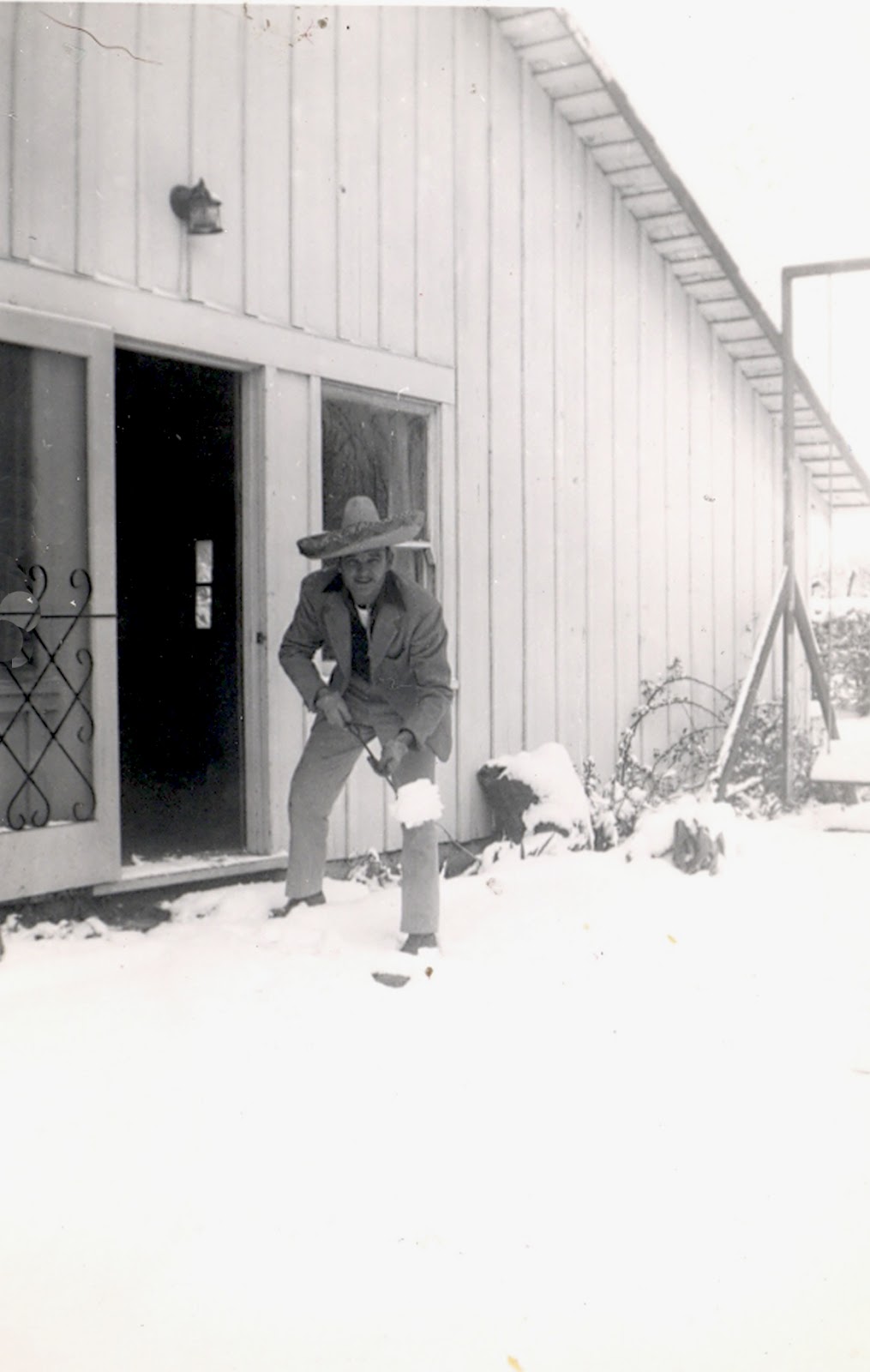
VAN NUYS SNOW PHOTOS FROM 1950

CHERISHING OUR VALLEY         2013

It's interesting to see what sorts of things energize folks, especially where their memories are concerned. Few things seem to annoy people more than the year/s the great San Fernando Valley snow/s occurred. Some photographs in The Museum's archives are marked 1948 and others 1949. There appear to even be conflicting newspaper accounts. 
Now to give passionate historians more to get excited about, here are a series of photographs just donated to The Museum of the San Fernando Valley from Arlene Bernholz with yet another date marked on the back of each image "1950".
What do you believe accounts for the differences in these dates?  Were there several great snowstorms?

 "House front - Sherman Way 1950 - Photos gift to The Museum of the San Fernando Valley from Arlene Bernholtz 2013  (click on images to enlarge them.)  Photo 5821P

Photo 5823

 This house was located at 17251 Sherman Way in Van Nuys. 
Photo 5822 - some damage on left front corner
 Snow covered ornamental shrubs - 1950 - Van Nuys.
This photograph reveals the address of the house, just by the bough of Christmas fir above the screen door.Photo 5825
 This woman holds a ping pong paddle, indicating that the table by which she is standing it part of a ping pong set. Photo 5816 - Notation reads: "After barn connected from Children's corner nursery school."

Photo 5817

 Snow covered outdoor bar-b-q place.   Photo 5818

 
Man in Mexican sombrero shoveling snow in 1950. Photo 5819

Saturday, May 12, 2012

LEARNING TO SKI IN SHERMAN OAKS IN THE 1950s


CHERISHING OUR VALLEY 2012 

In the 1950s, Valley residents who wanted to learn to ski might have considered Harold Larson's Viking Ski Center at 13733 Ventura Boulevard in Sherman Oaks. These great photographs are shared with The Museum Community by Priscilla Shipstad. 


The large wooden ski ramp at the Viking Ski Shop was on the corner of Ventura Boulevard and Mammoth Avenue in Sherman Oaks.

Monday, May 2, 2011

SISTERS OF THE IMACULATE HEART OF MARY TAUGHT IN ENCINO

DISCOVERING OUR VALLEY    2011

In 1947, seven Catholic nuns opened an elementary school at Our Lady of Grace parish in Encino. The teaching sisters were members of the Religious Order of the Immaculate Heart of Mary. Their former convent now serves as the parish offices.


In the chapel of the convent of Our Lady of Grace parish, this stained glass window was presented to the teaching sisters to celebrate the Holy Year of 1950. Note the triple crown of Pope Pius XII with his insignia crest of doves.

Wednesday, January 19, 2011

HISTORY'S LITTLE SURPRISES

DISCOVERING OUR VALLEY     2011

Your Museum hopes that you have your "Valley History Glasses" on by now, and are on the lookout for the large and small things that add up to our special heritage. Musuem Board member, Phyllis Hansen sends this along as a reminder for us all to be Valley detectives.  She found this invitation from 1950, the back of which was used as an index card.

Sunday, August 8, 2010

A SHORT HISTORY OF BIRMINGHAM HIGH SCHOOL IN THE SAN FERNANDO VALLEY

The following is a short history of Birmingham High School in the San Fernando Valley, provided by an alumna Ms. Gerrie Dodd of Beaverton, Oregon.

History of Birmingham High School
(Borrowed from BirminghamBraves.com)

April 1st, 1946. The end of World War II. 160 acres of prime Mid-San Fernando Valley land was covered by Birmingham Army Hospital for the wounded and maimed of our young men who had fought for their country.
Originally the Army had broken ground in the middle of what had been the Pettit family's carrot and lima bean field on June 18th, 1943. The cost per acre, $600. .
The hospital served the War Department in several medical capacities, including the care of German prisoners of war, until April 1st, 1946, when the grounds and buildings were transferred to the Veteran's Administration and was run as such until June 1st, 1950.
Valleyites were not happy seeing the 160 acre multi-million dollar plant sitting idle and deserted, but few put into action their thoughts. One who did, however, was Mrs. Albert Zoraster, a member of the Havenhurst Elementary School P.T.A. With a child approaching junior high-school age, she knew Van Nuys, Fulton and Sutter Junior High-schools were all crowded to overflowing. Then she recalled what a relative had mentioned some years before. Could the old hospital grounds be turned into a campus? Bringing the idea up at a future P.T.A. meeting, Mrs. Zoraster was quickly appointed as Chairman of the Committee on Birimingham. Her first move was a letter to Mr. James G. Moran, Secretary of the Van Nuys Chamber of Commerce. He in turn passed the proposal on to Dr. A.J. Stoddard, Superintendent of the Los Angeles Board of Education.
Things began to move more rapidly then. On July 24th, 1952 the grounds were surveyed by members of the staff and found to be remarkably well suited to school purposes, on a temporary basis. With that hopeful reply, the Committee on Birmingham went to work. Letters about Birmingham went out to every influential person from President Harry Truman to Mayor Andy Devine (acting fame) of Van Nuys on September 18, 1952.
Mrs. Zoraster and the committee continued their hard work by bringing the plans for the proposed school to the public eye. Proposals were made to the Army and on October 10th papers were signed for the lease (rumored to be $1.00/yr.) by the Army and the Los Angeles School Board....with certain limitations.
On October 13th, negotiations opened and a resolution was adopted by all agreeable parties. The Army would maintain ownership and control of the property facing Vanowen, becoming a Nike missile facility. The Junior High-School would get the East and core of the grounds which consisted of 53 acres, bordered on two sides by Balboa Blvd and the later-to-be Victory Blvd.
What was now about to happen is history. In just four short months Birmingham Hospital became a usable Birmingham Junior High School! The amazing transformation was due in part to the efficient and speedy handling of the project by the Board and the Administrative staff of Dr. Stoddard. But the man who did most to make the dream a reality was Dr. John I. Abbott, the new school's Principal. In the '54-'55 school year Birmingham became Birmingham High School.
During the ongoing construction of Birmingham, the student body was being formed. On February 4th, 1953, students living in the area that Birmingham would serve came together at Van Nuys Junior High School. The 'new' school operated out of portables on the grounds of the VNJHS campus as a 'second' school until April 7th, 1953, at which time the entire student body, 1200 8th graders, was transported by bus amid television cameras and newspaper photographers, arrived on the campus at Balboa Blvd. and Victory Blvd.


The grounds were vast. We had never walked so far in our young lives to get to a classroom! From the PE area to a class in Office Practice or Drama classes in the old Chapel (What a paradox; today school prayer is outlawed, in the '50's we had a real 'Chapel' on campus!) was a good quarter mile walk. Then there was the task of getting to lockers and getting to class at the appointed time. .
The buildings began to take shape as our young lives did. The swimming pool, at the beginning, was only a promise. It was there but it was filled with brackish water. Every once in a while we'd drop by and longingly look at it. Then in 1956, and after numerous fund raisers, the pool was cleaned and repaired. The class of ’57 was the first to jump in. Our competitive swim team was born, but where was the competition? A high school, in those days, with a pool was a rarity.
Since we had centered on being the "Braves" our clubs took on tribal name like Chieftains and Pottawattomi.
Many students would bring partial lunches and then chose to stand in the lines of the cafeteria. The spaghetti or macaroni and cheese built an acquired taste we were unable to duplicate. The little red and white 'boat' containers the food came in might have been the flavor enhancer. The GIANT oatmeal cookies were hard to duplicate. Oh, and they had to be four inches in diameter!
Our expansive lunch break left time to watch the first half of 'Picnic', the first third of 'Gone With The Wind', and if you got there early enough the complete movie of 'Pajama Game', 'Hondo', or 'Shane'. All this was happening at the theater, for ten cents. Those were the carefree days.
During the '53-'54 school year the wood shop teacher and a group of students discovered the on-campus 'morgue'. The 'morgue' was a boarded up room located between the woodshop and home economics room. It contained approximately 18 rolling body shelves, all oak hardwood doors and wood trim, posted directions regarding temperature controls, check list procedures, etc. To think that a 'morgue' would be sealed away in such a pristine condition on a school campus, similar to an Egyptian tomb, is eerie!
We were 'billed' as the "World's Largest Junior High School". Probably due to acreage; however, our spirit was big, the dreams were big, and, yes our minds had expanded also. No other school could have molded our young lives as did Birmingham. We were Birmingham, and Birmingham was us!
Long Live the "Braves"
, 1952

Why Birmingham alumni consider their school to be unique:

Attending a school that was a converted WW II Army hospital.
A Fire Station on campus, complete with fire engine.
A complete, refrigerated morgue.
A Chapel, complete with second story living quarters.
A bowling alley.
A completely enclosed hardwood racquetball/handball court.
An American Red Cross insignia on roof of administration offices.
Various hospital apparatus' attached to ceilings, walls, and floors.
A bomb shelter corridor system that replicated above ground corridors.
A movie theater complete with balcony and 16 mm projection room.
On-campus railroad tracks.
A swimming pool complete with bathhouse and cabana

Friday, September 18, 2009

SAVE THE DATE OCTOBER 21st

2009 The Year of Valley History
SAVE THIS DATE: October 21st. Board & Advisors Meeting of The Museum of the San Fernando Valley

The Mustang Van Nuys Jr. High S' 50 - Gift to The Museum of the San Fernando Valley from Gary Fredburg Sept.2009

This yearbook belonged once to Joan Shores in grade B 8th, Homeroom 208. The softcover book is filed with autographs of students and teachers. Unfortunately, along the way, four schoolmate photos were carefully clipped out. Such is life among pre-teens.

Do you have school year books from the greater San Fernando Valley? Call your Museum today (1-(818) 347-9665. We collect and preserve artifacts and documents related to schools and colleges in Southern California.